July 2nd, 2010 | 7 Comments »

One of the sweetest moments in an author’s life (well, her work life, anyway) is that moment when the printed book arrives in the mail—perhaps an advance copy, or the weighty box of author copies, destined for friends and reviewers. From the signing of a contract to finished printed copy can take a year or more, depending on the scope of the work, and here, finally, is tangible proof that you did something. You can pick it up! Turn its pages. It’s a Thing, and you made it. Naturally, you want to show it off to some friend who might admire it and say appreciative things. It’s basking time, after all.

I remember such moment, with such a book, and such a friend. The friend asked to see the book, and I handed it over. Friend opened the book to a random page in the middle, glanced down, and said, “What’s a ‘hoilday’?”

Um…. that would be a “holiday,” mistyped. It wasn’t the book’s title, or a main character’s name. It was only a photo caption. But still I felt bad about it, and of course I was bummed that it was the first thing the friend had seen! Though somehow it often seems to work out that way. You want to say, “Yes, but look how many words are spelled correctly!” though that just comes off as desperate.

An author checks her manuscript before sending it in. Computer spellcheckers help, of course. The editor checks it too (depending on the size and nature of the work, perhaps several editors), and then so does a copy editor, and sometimes also a proofreader. Copy edited pages might come back to the author who can check them again. The process is different with different publishers, but several people look over every manuscript.

So how do typos get through? I know I was a lot more critical of typos when I was an enthusiastic reader who had never published herself. My gosh, I’d think, what boob let that slip by? Were the people all drunk or asleep? But now, while I can’t put into words why typos get by, I know that they do. They do even when several very competent, careful, caring people all check the same page. Whatever the reason is, it is not (necessarily!) that the people involved are not good at what they do, or that they aren’t doing their best. In terms of inevitability, typos are up there before death, but after taxes (because some organizations are tax-exempt, right, and some states don’t have sales tax… whereas typos happen the world over).

A better question might be this: Once the book is published, and someone spots a typo, should anything be done about it? Well, of course mistakes should be fixed when 1) it is possible, and 2) it makes sense. “Sense” usually means—you guessed it—financial sense. Was my publisher going to recall and then reprint 20,000 books because “hoilday” appeared in a caption? Of course not. The error was not worth the expense it would take to correct it. In the case of the cook book that advised adding “freshly ground black people” instead of “black pepper,” the publisher had to reprint 7,000 copies at a cost of US $18,000.

So no, if you spot one instance where Steven has been rendered as Stephen, firing off an indignant letter isn’t going to accomplish anything. If you spot a mistake on every page, then you might consider sending a letter to … well, to whom? Authors, unless they self-publish, don’t have the authority or the means to reprint books. Yet readers can sometimes more easily find an email or blog site or something for an author than an editor; and of course authors can pass information on to their editor.

The only downside to informing an author that his hero Victor on page 54 has been miscast as Victim is that if nothing can be done about the mistake, the author just feels badly. A book is such hard work, and you get so emotionally invested with it, that it’s a bit of a let-down to think your readers are primarily concerned about whether the stationary should have been stationery. Of course we care. Words matter, and spelling conveys their beauty as well as their meaning. But we probably care more about plot, character, setting, and those lustful sex scenes.

It comes down to an individual preference, really. Personally? I want to know. If the mistakes can be fixed, I want to make sure that they do. (If you spot a typo in one of my blog posts, for example, tell me! and I will fix it). If they cannot, and there are a lot of them, I might want to let the publisher know in any case. To me, being informed is worth the feelings of disappointment I would invariably have.

I’ll put the question out to others, then. Authors: Do you want to know? Readers: How affected are you when you catch a typo, and what, if anything, do you usually do about it?

counter on tumblr


June 29th, 2010 | Comments Off on Review of The Secret Circus of Pain and Degradation

(Excerpt from Chapter 2 of The Secret Circus of Pain and Degradation by Fulani; Pink Flamingo Publications, 2010)

It had started, if not innocently, then with only with a lightly wicked sense of fun.

“Hmm,” Amy mused, covertly admiring the lean, muscled form of a circus-hand as he walked past, checking the guy-ropes. “The last time I was taken to a circus must have been twelve years ago, and I’m sure it was, well, not quite so abandoned.”

Paula looked at her with concern. “But you’d only have been about eight then,” she observed. “And you probably went to an afternoon show. Didn’t you like what we saw?”

Amy smiled, a slight twist of the mouth and a glint of cat-green eyes that didn’t quite reveal her thoughts. “On the contrary, maybe I liked it too much…”

The performance the two women have just attended was titillating; but there are other, darker performances given by this particular circus. Driven by curiosity, Amy and Paula attend the special after-hours show, where they are selected as “volunteers” for the hypnotism demonstration… and come to hours later as the circus’ newest recruits, restrained and forced to submit to the special training required by the sadistic ringmaster and his henchmen. It’s an inversion of the classic dream of running away to join the circus—here is a circus that runs away with you! Well, with them, anyway. But you’re free to imagine yourself in their places…

The Secret Circus is one of male domination and female submission. 113 pages of very well-written prose cover a wide range of power exchange acts—bondage, caning, collaring, flogging, humiliation, objectification, piercing, predicaments, training, wax play, whipping and more (I alphabetized those so as not to give away any plot sequences!); oh, and lots of sex, woven into an engaging plot.

A friend asked me, as I was reading this, if it would be a good book for him to give to his shy and conventional wife, in hopes of opening her up to slightly kinkier sex.

Well… no. There are other books out there that slowly introduce the mindset behind domination and submission—but this is not one of them. The audience for Secret Circus already knows the difference between domination and assault, and understands the mindset of a submissive who finds freedom in the act of surrendering control. Don’t pick up a book called The Secret Circus of Pain and Degradation if you’re not sure if a swat to the behind could ever feel good. But do pick it up if you’d like a mature erotic novel with strong BDSM themes.

A plot device I particularly loathe is the very common one of some character who “lectures” the audience through the means of “explaining” to some other character what is happening. “But before I kill you, Mr. Bond, let me show you exactly how my doomsday machine works.” That sort of thing. I hate that! And the Secret Circus has none of that. The two female protagonists are new to the lifestyle, but Fulani knows the difference between his characters and his readers, and treats both with respect. It’s a tricky thing, really, to show the evolution of a character without talking down to a more knowledgeable audience, and this book does it well, with the emphasis on showing, not telling.

The pacing of the plot is also appropriate. Amy and Paula don’t roll over and submit to new pleasures in five pages. Their training unfolds at a believable pace, with mixed feelings and reactions and inner turmoil described convincingly.

As the two women struggle and change and submit, other plot elements emerge, including a raid against the circus by a disgruntled private client, and the question of whether the traveling circus might be able to adapt to a permanent, stationary position in the city.

A circus theme allows for a variety of characters and types and scenes. I actually know a number of professional circus-type performers, so I was prepared to have to suspend belief a bit and not argue that this juggling act couldn’t be done, that aerialists would never behave like that, etc.; but I didn’t have to. The showmanship was believable as well as interesting. There is, of course, a overtone of exaggeration throughout—it’s fiction—but nothing that jars.

Am I allowed to say this in a review? It’s what my friends all asked me… “Did it pass the ‘wetness test’?”

Yes.

Oh my, yes.

*  *  *  *  *

The Secret Circus of Pain and Degradation is available as a print book and an e-book from Pink Flamingo Publications. Click here to order and to read an excerpt from the first chapter.

*  *  *  *  *


counter on tumblr


June 22nd, 2010 | 6 Comments »

I do a lot of my writing in coffee shops, little independently owned places with punny names along the lines of The Daily Grind, The Supreme Bean, Brewed Awakening, Higher Grounds, Brew Ha Ha, Java the Hut. (I wonder if British writers repair for refreshment to tea shops… and would those have cute names too? Tempest in a Teapot? Nooks and Grannies, for the older clientele? CeleBriTea?) The punishment (ha!) continues inside with the tip jars: Support counter intelligence. Afraid of change? Leave yours here! Feeling tipsy? Change is good. Show us your tips.

Erotic book titles often reach for the puns, in a way that Booker prize winners, for example, do not. Some of my favorites (for titles; I haven’t necessarily even read all of these, but their titles caught my eye):

Bottoms Up: Spanking Good Stories (Edited by Rachel Kramer Bussel)

Coming Attractions (S.L. Carpenter, Sahara Kelly)

Foreign Affairs: Erotic Travel Tales (Edited by Mitzi Szereto)

Good Cop, Bad Girl (Paige Tyler)

The Oy of Sex: Jewish Women Write Erotica (edited by Marcy Sheiner)

Rock My Socks Off (a novel in which rocking horses play a role) (Jeremy Edwards)

I don’t struggle so much with story titles; for one thing, it’s a shorter, more unified piece of writing to sum up. Thus, among mine, I have “Sales Pitch” for an encounter that takes place between a salesclerk and a customer; “Layover” for a meeting between flights in an airport; and “Schiphol” takes place in the Amsterdam airport, whose name is—surprise—Schiphol.

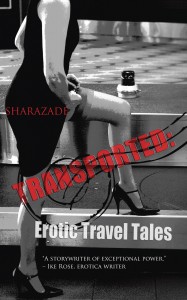
But naming a whole book is harder. Something too obscure doesn’t give the reader enough information; “Schiphol” for a whole book gives no indication as to what’s inside. And then, like smart sexy partners with no hang-ups, it seems like the good ones have already been taken. Foreign Affairs was gone, Wanderlust had been used (twice), and someone else had the simple Erotic Travel Tales.

Interestingly, titles of books cannot be copyrighted. So even if someone else has called her book Wanderlust, I am still free to do so. However, authors and publishers avoid this whenever possible, because it helps nobody to have your book confused with someone else’s. You look unoriginal, and your readers could be confused. If they buy someone else’s book instead of yours, you’ve lost your sale, and if they buy yours instead of the one they were really looking for, you’ve lost their good will.

I turned to my friends, thinking it might be easier to pick from a selection than to invent my own. Travel Sex? Too blunt. Jet Shagged? Too silly. Around the World in Eighty Ways? (“You could call your character Family Jules or Fellatio Fogg!” said the friend who suggested this one). And then finally…. Transported. It just felt right. It included travel, and it included sex without being too obvious. Definitions for transport range from “move something or somebody around; usually over long distances” to “ecstasy: a state of being carried away by overwhelming emotion” to “enchant: hold spellbound.”

Writers often use the metaphor of giving birth to explain how they feel about creating a book. I’d draw a parallel with names there, too. If you ask your friends what they think of your baby name before the child arrives, you might hear some negative opinions: “I worked with a Judy once; she was a total bitch.” “I had a cousin Judy—she died young.” But when you announce the birth of your child, everyone is supportive: “Oh, that’s a beautiful name.” “My favorite aunt was called Judy—a lovely, intelligent woman.”

Before its publication, I heard that Transported was too subtle a title, and also that it was too obvious. Once it came out, though, people just said that it was a nice catchy title. Thank you! It’s my baby, and I love her.

I have my next title already, actually. But I’m keeping it secret.

counter on tumblr


Posted in • Entitled
June 13th, 2010 | 9 Comments »

When I was working on the manuscript that became Transported, I gave one of the stories to a male friend to read. He isn’t someone who normally reads erotica, or even much fiction, so I was interested in his reaction: could I interest someone who didn’t naturally gravitate to that genre?

When he was done, he handed the pages back to me and said, “You write about sex like a woman.” I was more surprised by my reaction to his remark than the remark itself—I mean, the remark itself is not startling, is it? I am a woman. I have sex as a woman. It’s quite reasonable that I would write about sex “like a woman.” But without knowing quite why, I felt just little bit insulted. What did he mean, “like a woman”? I tried to get him to explain it, but perhaps he sensed some of my defensiveness, because he backed off, as if I were asking him “Does this story make me look fat?”

Is it an insult of sorts? I don’t think he meant it that way at all, but think of similar statements: You throw like a girl isn’t a compliment, and neither is Women drivers! Not that men have it any easier; if a woman says, Typical man! it’s probably not because he did anything good. With erotic writing, though, gender is important. Most characters are one or the other, and the reader needs to be able to believe this. (As an aside, I can’t help but think of one of the best bumper stickers I ever saw, which said, as a nod to Bob Dylan, I brake just like a little girl.)

Three of the stories in Transported have first-person male narrators. As dedicated as I am, I did not get a temporary sex change to write them. How could I do it, then? At the time I was writing, I asked myself the same thing; and my answer was that I didn’t need to sound “like a man,” but rather like a reader would expect a man to sound. A subtle difference, but a difference nonetheless.

Do men and women speak (and write) differently, as genders? There’s no easy answer. For every study claiming yes, there is another proving that it isn’t really so. It’s beyond the scope of this blog to go into all of the intricacies, but as someone who has studied the issue academically, I’ll give you my conclusion: Yes, there are differences, but they’re more related to power. That is, a higher-status person will talk more, will talk more directly, will interrupt more, and so on. It is a sad reality that at least in the US, men still have more power in many situations than women, and that influences how they talk. But power is also determined by age, experience, job position, family background, level of education, demonstration of expertise, and other such factors.

If you think of the thousands and thousands of novels and stories you have read that were written by men, you wouldn’t say that they all sounded the same. Not all men sound the same; not all women sound the same. However, it’s also true that I can almost always tell on online bulletin boards and lists whether a writer is male or female before a name or gender is offered. It isn’t words alone, of course, but also point of view and choice of topic—but something in the way many people write indicates their gender.

Any author has the same task of making characters sound believable, whether those characters are men or women or transgender or werewolves or space aliens. If a woman could only write “like a woman,” it would be hard to write convincing dialogues between a woman and a man. Nor does a woman (at least this one) want to write like the same woman in every story. That, to me, is really the challenge of writing short stories—to write very different characters believably, who act, and talk, in different ways. I often have a certain person’s “voice” in mind when I create characters; this helps me keep them consistent throughout the story.

I’ll close with a link to a site, The Gender Genie, that purports to be able to guess the gender of a writer by analyzing a chunk of text.

The Gender Genie

You input a chunk (the Genie points out that it works best with chunks of 500 words or more), indicate whether the genre is fiction, non-fiction, or blog (is that a dig at the truthfulness of blogs?), and the Genie will guess. Most people I know who’ve been to the site amuse themselves for a bit putting in different chunks of their own writing, perhaps hoping to discover something about their own identity they didn’t already know. What’s interesting is that the Genie also tells you which words it has tagged as “feminine” and “masculine,” and some of the choices will surprise you, I think.

I don’t think for one minute that the Gender Genie has all the answers. I’m not convinced, actually, that it has any of the answers. But it raises interesting questions for writers about how our word choices affect the impressions we give.

This blog entry, by the way, makes the Genie think I’m male: I rated a Male score of 1604 to a Female score of 1038. So I write about sex like a woman, and blog like a man. But I’m OK with that.

Oh, and I brake like a lady

counter on tumblr


June 11th, 2010 | Comments Off on Favorite sites

Writing, language, and erotica:

Erotica Readers and Writers Association A wealth of information and resources for readers and writers of erotica.

Erotica for All, run by Lucy Felthouse. A wonderful resource for erotica writers and readers. Has author profiles, author interviews, book reviews, calls for submission, and more.

My publisher, Fanny Press.

The Chicago Manual of Style. I enjoy their monthly Q & A!

~  ~  ~  ~  ~

Blogs by writers I like (in reverse alphabetical order, just because):

Willsin Rowe Erotica author, and also a skilled cover designer and trailer maker! He did the trailer for Transported.

Submission & Metaphor A personal blog by a submissive woman. Insightful and poetic. Just great writing!

Sommer Marsden My review of her clever Calendar Girl is here.

Shanna Germain, author of erotica and other genres. Shanna also teaches online writing classes from time to time; I took her erotic writing class Sexy on the Page, and recommend it. There are lessons, and you also get your work critiqued by her and other students, and there’s nothing like a deadline to help you get your stories finished! I was able to get sections of several of the stories in Transported critiqued when I took her class, and I found it very helpful.

R V Raiment, the personal blog of a writer of erotica.

M. Christian’s blog, Imagination is Intelligence with an Erection. He also maintains Frequently Felt, which publishes erotica and sundry. Why not submit something?

Lisabet Sarai An erotica writer with a particular gift for bdsm.

K D Grace Popular erotica author of novels and short stories

Kay Jaybee Blog form an insightful (and friendly!) erotica writer. Some free reads, too!

Jeremy Edwards, author of erotic fiction. His tag line says it all: If we can make our portrayal of sex even sexier than the reality of sex, then that’s erotica. My review of his delightful Rock My Socks Off is here.

Fulani’s Limited Attention Span, author of erotic fiction. Check out his circus book! And with writing from both Fulani and his partner, a new site, Deliciously Deviant.

Blowfish Blog Intelligent (and often humorous) discussions on issues related to sex.

*  *  *  *  *

    href=”http://www.statcounter.com/tumblr/” target=”_blank”> alt=”counter on tumblr” />


  • Facebook
  • Google+
  • Twitter